The Productivity J-Curve in Educational Technology Adoption: Understanding Institutional Transformation in the Digital Age
This phenomenon reflects what economists describe as the Productivity J-Curve, a pattern observed when organizations adopt new technologies that require complementary investments in skills, systems, and governance before measurable gains appear.
DIGITAL TRANSFORMATION - EDUCATION
Across the world, educational institutions are accelerating their adoption of digital technologies in order to improve teaching, administration, and institutional decision-making. Learning management systems, artificial intelligence tools, data analytics platforms, and digital governance frameworks are increasingly shaping how schools and universities operate. Yet despite this rapid technological adoption, many institutions initially experience a paradoxical outcome: productivity appears to decline before the benefits of digital transformation become visible.
This phenomenon reflects what economists describe as the Productivity J-Curve, a pattern observed when organisations adopt new technologies that require complementary investments in skills, systems, and governance before measurable gains appear. In education, this dynamic is particularly pronounced because teaching systems are deeply embedded in institutional cultures, pedagogical traditions, and regulatory frameworks.
Understanding the Productivity J-Curve is therefore critical for leaders seeking to guide institutions through digital transformation. Rather than interpreting early implementation challenges as failure, educational leaders must recognize that technological adoption often represents the beginning of a deeper institutional transformation. These dynamics are examined in detail in Digital Transformation in Education: Strategy, Systems, and Institutional Change, which explains how technology, governance, and institutional strategy interact in the modernization of education systems.
The Origins of the Productivity J-Curve
The concept of the Productivity J-Curve was popularized by economist Erik Brynjolfsson and collaborators studying the impact of digital technologies on organizational productivity. Their research demonstrated that organizations often experience a temporary decline in measured productivity after adopting new technologies such as information systems or artificial intelligence.
This decline occurs because technology adoption requires organizations to make intangible complementary investments. Employees must learn new skills, institutions must redesign workflows, and governance structures must adapt to new technological environments. During this transition period, resources are devoted to learning and restructuring rather than to immediate output.
Research conducted at MIT Sloan School of Management highlights that productivity improvements appear only after institutions align technology with organizational processes. Once these complementary investments take effect, organizations experience significant productivity gains.
In education, this same pattern appears when institutions adopt digital platforms, artificial intelligence tools, and learning analytics systems. Early implementation phases often require extensive teacher training, infrastructure investment, and curriculum redesign. While these efforts temporarily slow institutional productivity, they create the foundations for long-term transformation.
Technology Adoption in Education Systems
Educational institutions are increasingly integrating digital technologies into both teaching and administrative systems. Digital classrooms, online assessment tools, data analytics platforms, and artificial intelligence-enabled tutoring systems are transforming traditional educational models.
International organizations such as OECD and World Bank have emphasized that technology adoption can improve educational access, enhance learning outcomes, and support institutional decision-making. However, these benefits depend heavily on how effectively institutions integrate technology into their broader systems.
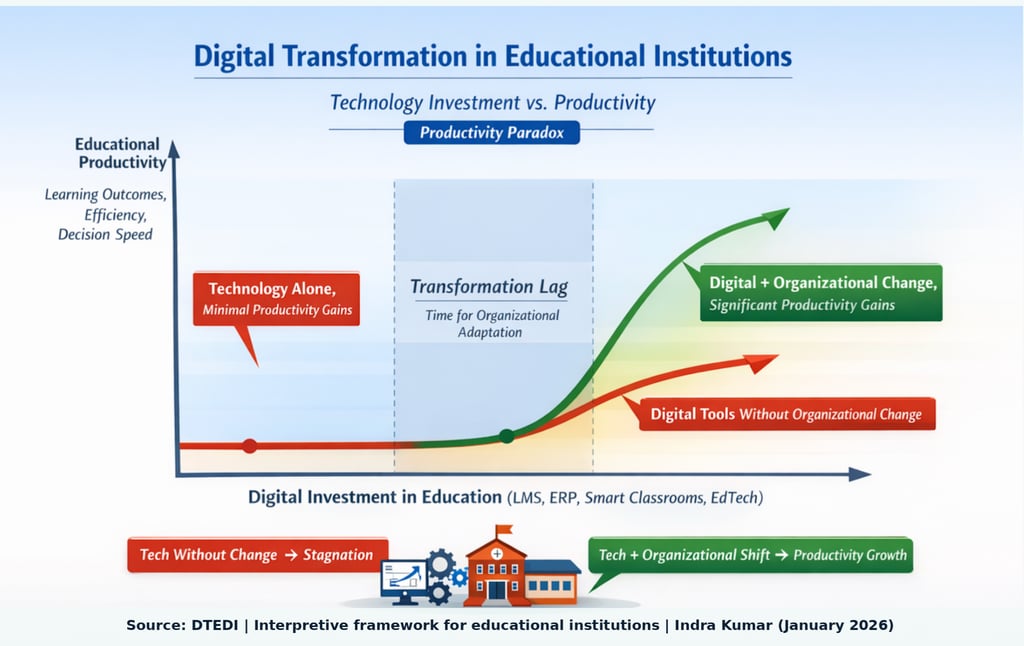
In many cases, schools initially adopt digital tools as isolated solutions to specific challenges. For example, a school may introduce an online learning platform without redesigning curriculum structures or teacher training programs. As a result, technology remains underutilized and fails to generate measurable improvements in learning outcomes.
The Productivity J-Curve explains why such outcomes occur. Technology alone rarely produces productivity gains. Instead, institutions must align technological adoption with broader institutional reforms, including governance frameworks, teacher development programs, and data management systems.
Why Productivity Appears to Decline Initially
During the early stages of technology adoption, educational institutions often experience a temporary decline in measured productivity. Teachers must learn new digital tools, redesign lesson plans, and adapt to technology-enhanced instructional models. Administrators must establish new governance frameworks for managing digital platforms and protecting institutional data.
These activities consume time and resources but are rarely captured by conventional productivity metrics. Educational systems traditionally measure productivity using indicators such as classroom hours, examination scores, or administrative efficiency. Such metrics often fail to capture improvements in learning quality, personalization, and institutional intelligence.
Brynjolfsson’s research demonstrates that early digital adoption frequently produces hidden productivity gains that become visible only after institutions complete the process of organizational transformation. For example, teachers may initially spend more time preparing technology-enhanced lessons, but these lessons can ultimately improve student engagement and comprehension.
These transitional dynamics illustrate the importance of understanding the Productivity J-Curve when evaluating digital transformation initiatives within the educational sector. Without this understanding, institutions may prematurely abandon promising innovations.
Intangible Complementary Investments
Successful technology adoption requires institutions to invest in several complementary areas that support digital transformation. These investments include teacher training, data infrastructure, governance policies, and curriculum redesign.
Teacher professional development is one of the most important components of these investments. Educators must develop the digital competencies required to integrate technology effectively into classroom instruction. Without such training, digital platforms may remain underutilized or misapplied.
Institutions must also develop robust data infrastructure capable of supporting digital learning systems. Learning analytics platforms, student information systems, and institutional dashboards enable administrators to interpret educational data and make informed decisions.
Governance frameworks represent another essential component of digital transformation. Institutions must establish policies governing data privacy, platform interoperability, and ethical technology use. These frameworks ensure that digital initiatives operate within transparent and accountable institutional structures.
Government initiatives around the world increasingly emphasize these complementary investments. In India, the Ministry of Education (India) has supported digital education initiatives through platforms such as DIKSHA and policy frameworks associated with the National Education Policy 2020.
Artificial Intelligence and Teacher Productivity
Artificial intelligence represents one of the most transformative technologies currently influencing education systems. AI-powered platforms can assist teachers in designing lessons, generating feedback for students, and analyzing learning behavior.
Research from McKinsey & Company suggests that generative AI tools can significantly enhance productivity in knowledge-intensive professions. In educational contexts, these tools may help teachers manage large classrooms, provide personalized feedback, and develop innovative teaching strategies.
Interestingly, studies indicate that AI technologies often benefit mid-skill workers the most. For teachers, this means that AI can transfer best instructional practices across the teaching workforce. Less experienced educators may gain access to pedagogical insights that previously required years of experience to develop.
Importantly, these tools do not replace teachers. Instead, they function as cognitive scaffolds, supporting educators in delivering higher-quality instruction. Evidence from temporary AI outages suggests that teachers retain many of the skills they develop while using AI tools, demonstrating that such technologies support learning rather than dependency.
Rethinking Productivity Metrics
Traditional productivity metrics often fail to capture the full impact of digital transformation in education. Standardized examinations and administrative efficiency indicators rarely measure improvements in student engagement, conceptual understanding, or critical thinking skills.
Artificial intelligence and digital learning platforms can produce improvements in these qualitative dimensions of education long before measurable improvements appear in standardized test results. Students may learn more efficiently, collaborate more effectively, and develop stronger problem-solving abilities.
Educational researchers therefore emphasize the need for new evaluation frameworks capable of capturing these benefits. Learning analytics, competency-based assessments, and longitudinal studies of student outcomes may provide more accurate indicators of educational performance.
The Turning Point of the J-Curve
Over time, as institutions adapt their systems and develop new capabilities, the Productivity J-Curve begins to turn upward. Teachers become more comfortable using digital tools, administrative systems become more efficient, and learning environments become more personalized.
At this stage, the benefits of digital transformation begin to appear more clearly. Students experience improved learning outcomes, teachers gain access to powerful instructional tools, and administrators develop greater visibility into institutional performance. Educational institutions that successfully navigate this transition often develop significant advantages in innovation and adaptability. They become capable of responding more effectively to changes in educational demand and technological development.
The Productivity J-Curve provides an essential framework for understanding how educational institutions experience digital transformation. While technology adoption may initially appear to reduce productivity, this decline often reflects the necessary transition phase during which institutions invest in complementary capabilities.
Teacher training, data infrastructure, governance frameworks, and curriculum redesign are critical components of this transformation. Once these investments take effect, institutions can realize the full benefits of digital technologies. Artificial intelligence and other emerging technologies will continue to reshape education systems worldwide. However, the success of these technologies depends on how effectively institutions manage the transition process represented by the Productivity J-Curve.
References:
Erik Brynjolfsson, Daniel Rock & Chad Syverson — The Productivity J-Curve: How Intangibles Complement General Purpose Technologies https://www.nber.org/papers/w25148
https://www.dtedi.com/digital-transformation-in-education-strategy-systems-and-institutional-change
MIT Initiative on the Digital Economy — The Productivity J-Curve: How Intangibles Complement Technology https://ide.mit.edu/sites/default/files/publications/2019-04JCurvebrief.final2_.pdf
OECD — Digital Education Outlook 2023 https://www.oecd.org/en/publications/2023/12/oecd-digital-education-outlook-2023_c827b81a.html
World Bank — Education and Technology Overview https://www.worldbank.org/en/topic/edutech
UNESCO Global Education Monitoring Report — Technology in Education https://gem-report-2023.unesco.org/technology-in-education/
Research synthesis — Holistic Approaches to EdTech Effectiveness https://pmc.ncbi.nlm.nih.gov/articles/PMC10293898