The Five Pillars of Digital Transformation: Strategy, Technology, and Organizational Change
Blog post description.
DIGITAL TRANSFORMATION
Indra Kumar
3/3/20267 min read
Organizations across industries are navigating one of the most profound structural changes in modern economic history: digital transformation. Advances in computing power, data analytics, artificial intelligence, connectivity infrastructure, and cloud platforms have dramatically reshaped how institutions operate, compete, and create value.
Digital transformation is often misunderstood as the adoption of new technologies. In reality, it represents a far deeper shift in organizational architecture. It involves redesigning business models, restructuring operational processes, transforming customer interactions, building new technological infrastructures, and cultivating digital skills across the workforce.
Research from MIT Sloan School of Management, global policy frameworks developed by the OECD, and development perspectives from the World Bank all converge on a central insight: successful digital transformation requires a coordinated evolution across multiple organizational dimensions. Technology alone does not transform organizations; transformation occurs when strategy, processes, people, and infrastructure evolve together.
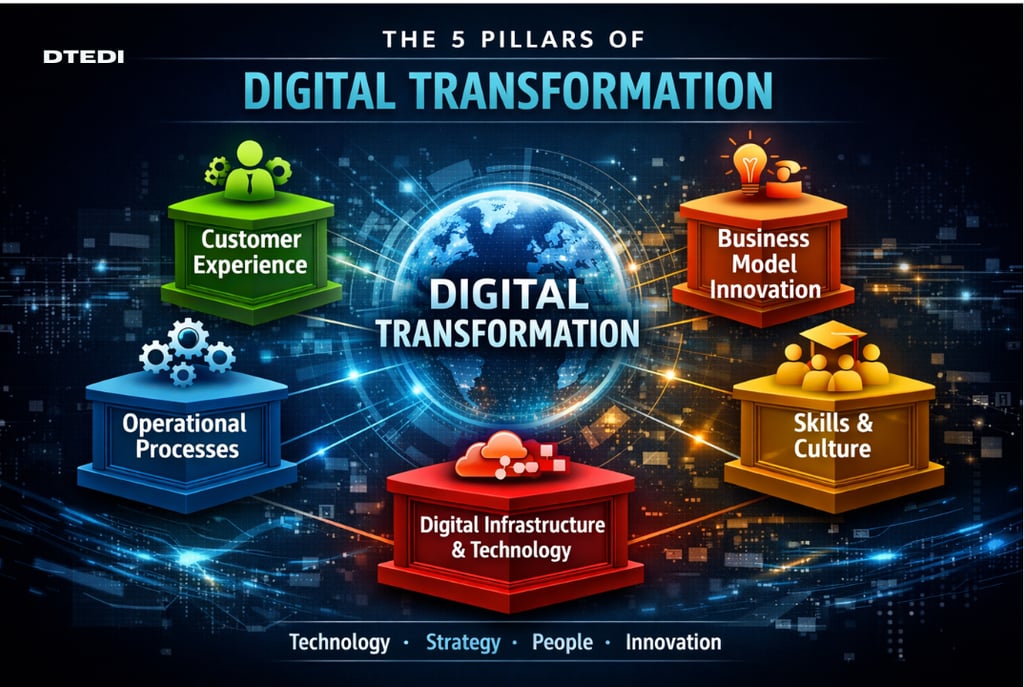
This article explores the five pillars of digital transformation, a framework that captures the essential elements organizations must address to successfully navigate the digital age. These pillars—customer experience, operational processes, business models, technology infrastructure, and organizational capabilities—form the structural foundation for building digitally enabled institutions capable of sustained innovation and long-term competitiveness.
Understanding Digital Transformation
Digital transformation refers to the strategic integration of digital technologies into every aspect of an organization’s operations, decision-making processes, and value creation systems. Rather than focusing solely on upgrading information systems, digital transformation involves fundamentally rethinking how organizations function in an increasingly digital environment.
Several forces are accelerating the global shift toward digital transformation.
First, customer expectations have changed dramatically. Consumers increasingly expect seamless digital interactions, personalized services, and the ability to access products or information anytime and anywhere. Digital platforms, mobile applications, and online ecosystems have become central to modern economic activity.
Second, competitive dynamics have evolved. Digital-native companies frequently disrupt established industries by leveraging technology to create new business models. Traditional organizations must adapt quickly to remain competitive.
Third, technological innovation continues to expand the possibilities for digital transformation. Artificial intelligence, cloud computing, advanced analytics, and connected devices enable organizations to operate with unprecedented levels of intelligence, efficiency, and scalability.
As a result, digital transformation has become a strategic imperative across sectors including finance, healthcare, education, manufacturing, government, and retail.
Why Digital Transformation Matters
Digital transformation matters because it fundamentally changes how organizations generate value. Institutions that successfully integrate digital technologies into their strategies often achieve significant improvements in performance, agility, and innovation capacity.
One of the most important benefits of digital transformation is improved customer engagement. Digital technologies allow organizations to better understand user behavior, deliver personalized experiences, and respond rapidly to changing preferences. Operational efficiency also improves when organizations adopt digital processes. Automation systems reduce manual work, data analytics improve decision-making, and digital workflows streamline coordination across departments.
Another critical benefit is the ability to innovate more rapidly. Digital technologies enable organizations to test new ideas, launch products faster, and respond quickly to market changes.
Finally, digital transformation increases resilience. Organizations equipped with digital capabilities can adapt more effectively to disruptions such as economic crises, technological shifts, or global events that reshape markets. However, achieving these benefits requires a structured approach that addresses multiple dimensions of transformation simultaneously. This is where the five pillars of digital transformation become essential
Pillar One: Customer Experience Transformation
The first pillar of digital transformation focuses on redesigning how organizations interact with customers, users, or stakeholders. In many industries, digital transformation begins with the goal of improving customer experience. Digital technologies allow organizations to collect and analyze data about customer behavior, preferences, and interactions. By leveraging these insights, organizations can design more personalized and responsive services.
For example, digital banking platforms allow customers to manage accounts, transfer funds, and access financial information through mobile applications. Retail companies use data analytics to recommend products based on past purchases. Online education platforms provide flexible learning experiences accessible from anywhere.
Customer experience transformation also involves creating seamless interactions across multiple channels. Modern customers may interact with organizations through websites, mobile apps, social media, or physical locations. Digital transformation ensures these channels work together in an integrated ecosystem.
Research from MIT Sloan School of Management highlights customer engagement as a core driver of digital transformation strategies. Organizations that prioritize customer experience often gain competitive advantages by building stronger relationships with their users. Ultimately, the first pillar of digital transformation emphasizes a simple principle: digital technologies should enhance the value organizations deliver to the people they serve.
Pillar Two: Operational Process Transformation
The second pillar focuses on transforming internal operations. Digital technologies enable organizations to redesign workflows, automate tasks, and optimize resource utilization.
Operational transformation often begins with process digitization—the conversion of manual or paper-based processes into digital systems. Once processes become digital, organizations can analyze data generated by these systems to identify inefficiencies and opportunities for improvement.
Automation technologies play a critical role in operational transformation. Robotic process automation can handle repetitive administrative tasks, freeing employees to focus on higher-value activities. Artificial intelligence systems can analyze complex datasets to support strategic decision-making.
Cloud computing also supports operational transformation by enabling organizations to scale resources dynamically and collaborate across geographic boundaries.
In many industries, operational transformation leads to significant improvements in productivity and efficiency. Manufacturing companies use digital sensors to monitor equipment performance in real time. Logistics companies use data analytics to optimize delivery routes. Healthcare systems use digital platforms to coordinate patient care.
Operational transformation therefore represents a powerful driver of organizational performance in the digital age.
Pillar Three: Business Model Innovation
Digital transformation frequently leads organizations to rethink how they create and capture value. This third pillar focuses on business model innovation. Traditional business models often rely on physical products, linear supply chains, and localized markets. Digital technologies allow organizations to create entirely new economic structures.
One example is the rise of digital platforms. Platform-based businesses connect multiple groups of users—such as buyers and sellers or service providers and customers—within a single digital ecosystem.
Another example is the shift toward subscription-based services. Many organizations now generate revenue through recurring subscriptions rather than one-time product sales. Data-driven services represent another emerging business model. Organizations increasingly use data analytics to offer insights, predictive services, and personalized recommendations.
Digital transformation also enables organizations to create entirely new markets. Companies can reach global audiences through digital platforms, reducing geographic limitations. Business model innovation is often the most transformative aspect of digital transformation. When organizations successfully redesign their business models, they can fundamentally reshape their industries.
Pillar Four: Digital Infrastructure and Technology
The fourth pillar focuses on the technological foundations that enable digital transformation. Without modern digital infrastructure, organizations cannot effectively implement transformation strategies.
Digital infrastructure includes several key components.
Cloud computing platforms provide scalable computing resources and flexible data storage. Organizations can deploy applications rapidly and scale operations without investing heavily in physical infrastructure.
Artificial intelligence and machine learning technologies allow organizations to analyze large datasets, automate decision-making processes, and generate predictive insights.
Internet of Things devices connect physical systems to digital networks. Sensors embedded in machines, vehicles, and infrastructure generate real-time data that organizations can use to optimize performance.
Advanced data analytics platforms enable organizations to transform raw data into actionable intelligence. By analyzing patterns and trends, organizations can make more informed strategic decisions.
Cybersecurity systems also form a critical component of digital infrastructure. As organizations become increasingly digital, protecting sensitive data and systems becomes essential.
The World Bank highlights digital infrastructure as a key foundation for building inclusive digital economies and supporting institutional transformation across both public and private sectors.
Pillar Five: Skills, Culture, and Leadership
The final pillar of digital transformation focuses on people. Technology alone cannot transform organizations. Successful transformation requires new skills, new leadership approaches, and cultural change.
Digital transformation often requires employees to adopt new tools, learn new capabilities, and adapt to evolving workflows. Organizations must therefore invest in digital skills development across the workforce.
Leadership also plays a crucial role in transformation. Executives must articulate clear digital strategies, align organizational resources, and support experimentation and innovation.
Cultural change is another essential element. Traditional organizations may resist change due to established practices or hierarchical structures. Digital transformation often requires more agile and collaborative cultures that encourage learning and experimentation.
The OECD emphasizes that digital transformation depends heavily on the development of digital skills, governance frameworks, and institutional capabilities. Without these human and organizational foundations, technological investments may fail to produce meaningful results.
Thus, the fifth pillar reminds us that digital transformation is ultimately a human transformation as much as a technological one.
Integrating the Five Pillars
Although each pillar represents a distinct dimension of transformation, they are deeply interconnected.
Customer experience improvements often require new operational processes. Operational transformation depends on modern technology infrastructure. Business model innovation may require new digital skills and leadership capabilities.
Organizations that focus on only one pillar—such as technology adoption—may struggle to achieve meaningful transformation. Successful digital transformation occurs when all five pillars evolve together.
This integrated approach allows organizations to build digital ecosystems that combine technology, strategy, processes, and people into a coherent system of value creation.
Challenges in Digital Transformation
Despite its potential benefits, digital transformation can be difficult to implement.
Many organizations face challenges integrating legacy systems with modern technologies. Older infrastructures may limit the ability to adopt cloud platforms or advanced analytics.
Cultural resistance to change can also slow transformation efforts. Employees may feel uncertain about new technologies or fear disruptions to established workflows.
Another challenge involves aligning transformation initiatives with strategic goals. Without clear leadership and governance, digital projects may become fragmented and fail to produce measurable results.
Organizations must therefore approach digital transformation with clear strategies, strong leadership, and structured frameworks that guide implementation.
The Future of Digital Transformation
Digital transformation will continue to shape the global economy for decades to come. Emerging technologies such as artificial intelligence, quantum computing, advanced robotics, and immersive digital environments will create new opportunities and challenges.
Organizations that build strong digital foundations today will be better positioned to adapt to future technological changes. The five pillars of digital transformation provide a useful framework for understanding how organizations can navigate this complex landscape. By focusing on customer experience, operational processes, business models, technology infrastructure, and organizational capabilities, institutions can develop resilient strategies for long-term success in the digital age.
References
DTEDI
Engineering the Future of Education
Copyright © 2026 DTEDI. All Rights Reserved.
LinkedIn :