Prohibited Marketing Activities in India (2026)
Legal, Strategic, and Enforcement Reality in the Age of Consent
DIGITAL TRANSFORMATION - EDUCATION
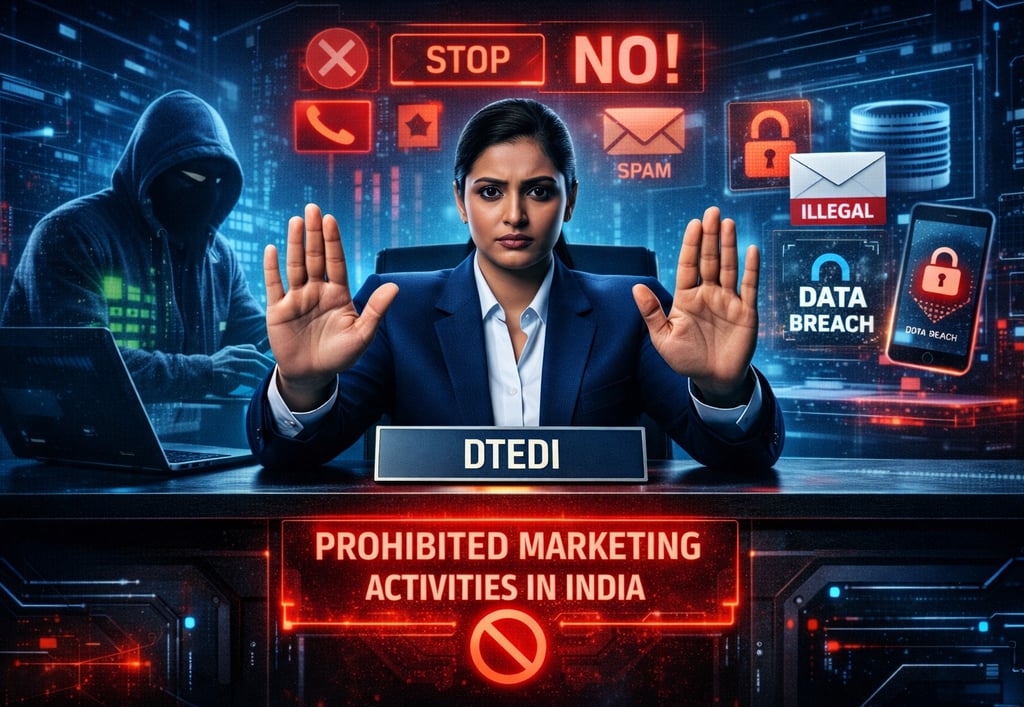
Data-driven marketing to Consent-governed marketing
India is undergoing one of the most significant shifts in the history of marketing regulation. What was once an ecosystem driven by aggressive outreach, database accumulation, and scale-first thinking has now transitioned into a tightly governed, consent-driven framework where every communication must be justified, recorded, and legally defensible. The era of growth hacking where businesses could experiment freely with cold outreach, mass messaging, and loosely defined user acquisition strategies is being systematically replaced by what can only be described as compliance-first marketing. At the center of this transformation lie three powerful regulatory pillars that collectively define the boundaries of marketing in India today.
Three pillars now govern everything:
TRAI (Telecom) → Controls SMS, calls, spam
DPDP Act 2023 → Controls personal data usage
IT Act 2000 + Cyber Laws → Controls digital fraud, misuse, breaches
If you violate these, they are not just “non-compliant.” You are legally exposed + business shutdown risk. This shift is profound. Earlier, growth teams could prioritize scale and optimize later for compliance. Today, compliance is the foundation, not an afterthought. Marketing is no longer about how aggressively you can reach users, but how legitimately you are allowed to access them.
Cold SMS & TRAI DLT Violations — Structural Breakdown & Implications
Cold SMS marketing in India is not just “discouraged” it is systemically blocked and legally punishable under TRAI’s Unsolicited Commercial Communication (UCC) regulations. The Distributed Ledger Technology (DLT) framework introduced by TRAI is designed to eliminate spam at the infrastructure level. Every business entity must register as a “Principal Entity,” every sender ID must be approved, and every message template must be pre-verified. This means marketing communication is no longer free-flowing it is pre-authorized communication only.
From a legal standpoint, sending SMS without explicit user consent constitutes a violation, regardless of intent. Even if the content is useful (e.g., job alerts), without recorded consent mapped to a telecom-verified ledger, it is still illegal. TRAI has empowered telecom operators (Jio, Airtel, Vi) to act as enforcement gateways. This means your messages won’t even reach users they are filtered at the network level.
The implication is massive: Cold outreach via SMS is structurally dead in India. Businesses that rely on purchased databases or scraped numbers are operating in a legally fragile zone. Penalties can escalate to lakhs per violation, but the bigger risk is blacklisting of sender IDs and permanent telecom bans, effectively shutting down your communication channel. Strategically, this forces a complete shift from outbound interruption marketing to inbound consent-based marketing. The only scalable path now is building opt-in ecosystems (landing pages, apps, communities) where users voluntarily subscribe.
Outsourced Marketing, In-House Liability: The Hidden Risk of Cold SMS Campaigns
In a typical real-world situation, a educational institution engages a marketing agency to increase admissions, and the agency decides to run a campaign by sending bulk SMS messages to a purchased database of student or parent phone numbers. At first glance, the educational institution may assume that since the execution is handled by the agency, the responsibility also lies with the agency. However, under India’s regulatory framework governed by TRAI and the Digital Personal Data Protection (DPDP) Act, liability is not something that can be outsourced. The law does not differentiate between who physically sent the message and who ultimately benefits from the communication.
In this scenario, the educational institution is treated as the “Principal Entity,” meaning it is the primary beneficiary of the communication, while the agency is merely acting as a processor or vendor executing instructions. Therefore, if the activity itself is illegal such as sending cold SMS messages without user consent both the agency and the school become accountable, but the school carries the primary exposure because the communication is being done in its name and for its benefit.
From a telecom regulatory perspective, this situation becomes even more structured and traceable under TRAI’s Unsolicited Commercial Communication (UCC) regulations and the Distributed Ledger Technology (DLT) framework. Every SMS that is sent through telecom networks is not anonymous; it is linked to multiple identifiers including the entity (in this case, the school), the sender ID, the approved message template, and the consent trail of the recipient. If the marketing agency sends cold SMS messages without proper consent, the system flags these communications. As a result, sender IDs can be blocked, the entity itself can be blacklisted, and telecom operators such as Jio, Airtel, and Vodafone Idea may suspend messaging capabilities entirely. The critical point here is that even if the agency executed the campaign, the brand name being promoted is that of the institution, and therefore the liability firmly attaches to the institution. The telecom system does not recognise the agency as the primary actor; it recognises the entity whose communication is being delivered.
A common misconception in such situations is whether it makes a difference if the school was aware of the activity or not. In legal terms, the distinction between “knowingly” and “unknowingly” has limited protective value. If the school knowingly allowed the agency to send cold SMS messages using purchased data, then the liability is direct and clear, with a strong case for regulatory action under TRAI and potentially under the DPDP Act if data misuse is involved. However, even if the school was unaware of the agency’s actions, it is still exposed under the principle of due diligence failure. The law expects organizations to exercise oversight over their vendors, implement compliance checks, and maintain approval systems for communication activities. Simply claiming ignorance does not absolve responsibility. In fact, it can be interpreted as negligence in governance. This reinforces the idea that compliance is not just about direct actions but also about how well an organization supervises its partners.
When viewed through the lens of the DPDP Act, the situation becomes even more critical. If the marketing agency uses a purchased database, it is highly likely that the data was collected without valid, explicit consent from the individuals. Using such data for marketing purposes constitutes illegal processing. In this framework, the school is classified as the “Data Fiduciary,” meaning it holds primary responsibility for how personal data is used, while the agency is categorized as a “Data Processor,” acting on behalf of the school. If a violation occurs, the school faces higher penalties because it is responsible for determining the purpose and means of processing the data. The agency is not free from liability, but its role is secondary. This clearly establishes that engaging a third-party vendor does not transfer ownership of compliance obligations.
Beyond legal exposure, the reputational consequences of such actions are often more severe and long-lasting. In the context of education, trust is the most valuable asset. When parents or students receive unsolicited messages, they do not differentiate between the school and the agency; they associate the communication directly with the institution. This leads to perceptions such as “the school is spamming” or “the school misuses personal data.” Over time, this erodes trust, which directly impacts admissions and brand credibility. Unlike commercial sectors where aggressive marketing may be tolerated, education operates in a trust-driven ecosystem where even a single misstep can cause long-term damage. The reputational fallout can extend beyond immediate admissions cycles, affecting partnerships, faculty perception, and overall institutional standing.
The operational risk chain in such scenarios follows a predictable pattern. The agency sends cold SMS messages to a large number of recipients. Some users mark these messages as spam, triggering complaints within the telecom network. These complaints are logged and monitored by telecom operators, which then flag the entity associated with the messages. Once flagged, sender IDs may be blocked, and the school’s name becomes tagged within the system. This restricts future communication attempts, even for legitimate campaigns. In extreme cases, the entire communication ecosystem of the school can be disrupted, making it difficult to reach even those users who have genuinely opted in. What begins as a seemingly simple marketing activity escalates into a systemic restriction on communication capabilities.
This entire situation reveals a deeper strategic reality. Allowing practices such as using purchased databases or running cold SMS campaigns is not merely a marketing decision; it is a governance failure. It indicates a lack of internal controls, absence of compliance awareness, and insufficient oversight of external partners. In a regulatory environment that is increasingly strict, such gaps can have cascading consequences across legal, operational, and reputational dimensions.
In contrast, institutions that understand this shift adopt fundamentally different approaches. They move towards consent-driven systems such as website-based lead capture, where users voluntarily provide their information, event registrations that include explicit opt-in mechanisms, WhatsApp communication flows that require user initiation, and CRM systems that maintain detailed consent logs. In these models, every communication is based on a simple principle: the user has requested or agreed to receive it. This transforms marketing from an intrusive activity into a responsive one, aligning with both regulatory requirements and user expectations.
Liability in such cases is shared between the agency and the school, but accountability rests primarily with the educational institution. The risks are not confined to legal penalties; they extend to operational disruptions and reputational damage. Ultimately, if a marketing agency is sending cold SMS messages using purchased data, the activity cannot be classified as legitimate marketing. It is operating within a compliance violation zone, exposing the institution to risks that far outweigh any short-term gains.
Digital Consent Framework — The New Power Shift to Users
India’s digital consent architecture, reinforced by TRAI and aligned with global privacy standards, marks a fundamental power shift from businesses controlling communication to users controlling access. Consent is no longer a checkbox it is a verifiable, auditable digital artifact stored across telecom and platform ecosystems.
For consent to be valid, it must be:
Explicit (no pre-ticked boxes)
Purpose-specific (cannot reuse for other campaigns)
Revocable (user can withdraw anytime)
This destroys traditional marketing shortcuts where companies bundled consent into long terms and conditions. Now, if a user gives consent for “admission updates,” you cannot legally send “course promotions” unless separately authorized. The implication is deeper than compliance it changes how funnels are designed. Marketing now requires intent capture, not just data capture. You need systems that track:
When consent was given
What purpose it covers
Whether it is still valid
This introduces operational complexity but strategic clarity. Businesses that design clean consent architectures gain long-term trust and scalability. Those who ignore it face legal risk and reputational damage. This is India’s version of GDPR thinking: “Access to a customer is earned, not assumed.”
Cold Calling, Telemarketing & Voice Spam — The Next Enforcement Wave
While SMS spam has already been tightly regulated, voice-based spam (calls, robocalls, AI calls) is the next major enforcement frontier. TRAI’s regulations prohibit telemarketing to users registered under Do Not Disturb (DND), and violations can lead to penalties, number disconnection, and enterprise blacklisting. Cold calling without consent falls into a grey-to-illegal zone depending on execution. If you are calling random numbers without prior opt-in, especially using automated dialers, it is considered intrusive and potentially illegal. Masking numbers or rotating SIM cards to bypass detection is a direct violation and can trigger telecom-level blocking.
The implication is voice is becoming as regulated as SMS. For institutions (schools, edtech, coaching centers), this is critical. Many still rely on admission calling teams using purchased leads. This model is legally unsustainable. Even if enforcement is uneven today, the regulatory trajectory is tightening.Strategically, this forces a redesign of sales processes:
Replace cold calling with warm inbound leads
Use appointment-based calling (user-initiated)
Build CRM-integrated consent logs
Future-ready businesses will treat calls as conversion tools, not acquisition tools.
DPDP Act 2023 — Data Ownership, Purpose Limitation & Marketing Collapse
The Digital Personal Data Protection (DPDP) Act 2023 is the most disruptive law for marketing in India. It fundamentally changes the nature of data from an asset you can exploit to a liability you must justify. The law introduces three critical constraints:
Purpose Limitation: Data collected for one reason cannot be used for another. If a student signs up for “exam updates,” you cannot legally use that data for unrelated promotions.
Consent-Driven Processing: No consent, no data usage. Even storing data without valid purpose can be questioned.
Right to Erasure: Users can demand deletion of their data. You must comply.
This kills the traditional “build a database and monetize it forever” model.
The implication is brutal:
Data hoarding becomes illegal
Retargeting becomes restricted
Third-party data sharing becomes risky
This means building data governance systems, not just marketing funnels. You need:
Consent logs
Data lifecycle management
Deletion workflows
Failure to comply can lead to penalties running into crores and reputational damage that destroys institutional trust. Strategically, the shift is from data-driven marketing to consent-governed marketing.
Data Breach & Security Liability — The Silent Killer
Under Indian cyber laws and the DPDP Act, data security is enforceable responsibility. If you collect user data (names, phone numbers, emails), you are legally obligated to protect it using reasonable security practices. A data breach whether due to weak systems, poor vendor management, or internal negligence can expose you to:
Legal penalties
Mandatory reporting obligations
Civil liability
Loss of institutional credibility
For example, if a school or EdTech platform leaks student data, it is not just a technical failure it becomes a legal violation. The implication is that marketing teams can no longer operate independently of technology and security. Every campaign that collects data must integrate with:
Secure storage systems
Access controls
Encryption protocols
This introduces a new layer Marketing is now part of risk management. Companies that ignore this will face catastrophic trust erosion.
Email Marketing & Cross-Border Compliance — The Hidden Risk
India does not yet have a strict standalone email spam law like the US CAN-SPAM Act, but email marketing is still governed under the DPDP Act and global regulations if you operate internationally. Sending emails without consent, using misleading subject lines, or failing to provide unsubscribe options can expose you to legal risk. If your audience includes users from Europe or other regions, GDPR or similar laws may apply, increasing complexity. The implication is that email marketing must follow global best practices, even if Indian enforcement is evolving:
Clear opt-in
Transparent identity
Easy unsubscribe
For founders building scalable brands, email should not be treated as a cheap blast channel. It must be treated as a relationship channel.
Social Media & Influencer Marketing Violations — Trust vs Manipulation
Social media marketing in India is regulated through a mix of IT rules and ASCI (Advertising Standards Council of India) guidelines. The biggest violation here is deception. Using fake followers, bots, or manipulated engagement creates a false perception of credibility. Influencers must disclose paid promotions clearly (#Ad, #Sponsored). Failure to do so is considered misleading advertising.
For education brands, this is critical. Promising unrealistic outcomes (“100% job guarantee,” “top rank assured”) without proof can trigger regulatory scrutiny. Social media is no longer unregulated it is reputation-sensitive and legally accountable. Brands that manipulate perception may grow fast but collapse faster when exposed.
Misleading Advertising & Consumer Protection — Legal Exposure Beyond Marketing
Under consumer protection laws, misleading advertising is a punishable offense. This includes:
False claims
Exaggerated results
Hidden conditions
In education, this is especially sensitive. Claims about placements, rankings, or results must be backed by evidence. The implication is: Marketing is now legally tied to truth, this forces alignment between, product reality and marketing messaging. Any gap becomes legal risk.
Grey Zone Practices — What Works Today but Will Break Tomorrow
There are practices widely used in India that are not always strictly illegal today but are moving towards enforcement:
WhatsApp bulk messaging without consent
Scraping leads from websites
Buying databases from vendors
These operate in a regulatory grey zone but violate the spirit of DPDP and TRAI frameworks. If your growth depends on these, your business is built on unstable ground. Smart founders exit grey zones early.
India is transitioning into a Permission Economy, Not theory. Structural shift, you cannot buy attention, you cannot force communication and you cannot exploit data, you must earn access.