Productivity J-Curve in DT-Education

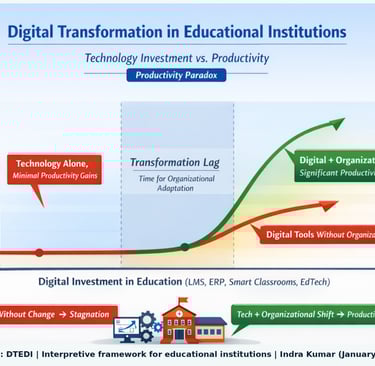
When schools, colleges, and universities introduce AI whether for lesson planning, assessment, student support, administration, or personalization measured productivity often declines initially, even though real value is being created.

DIGITAL TRANSFORMATION - EDUCATION

Indra Kumar

1/14/20262 min read

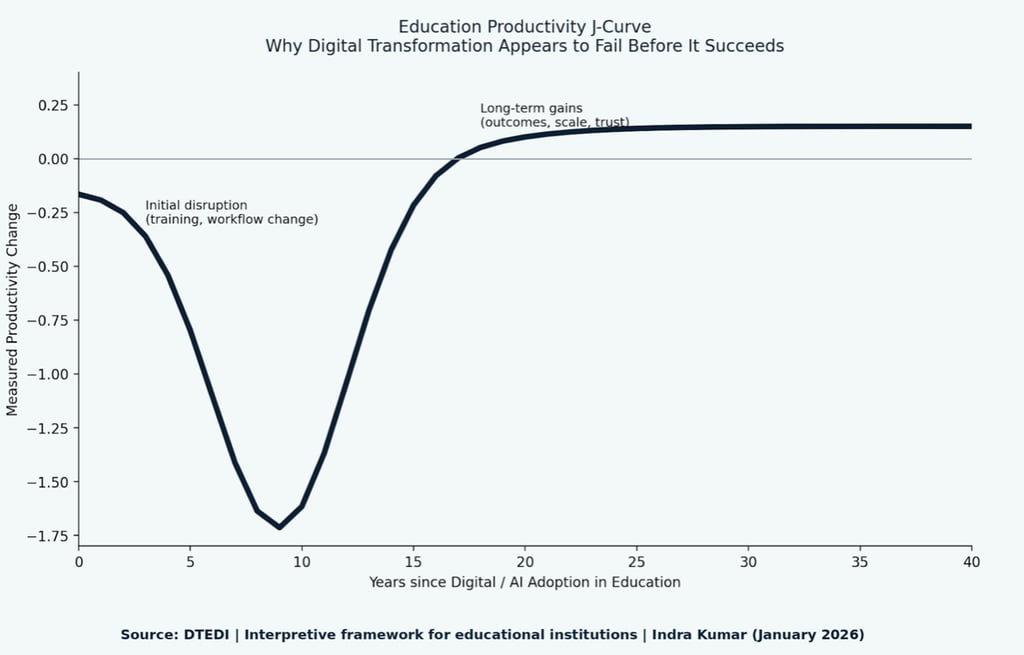
Digital transformation and AI adoption in the education sector follow the same Productivity J-Curve identified by Erik Brynjolfsson and his collaborators. When schools, colleges, and universities introduce AI whether for lesson planning, assessment, student support, administration, or personalization measured productivity often declines initially, even though real value is being created.

This early dip occurs because education systems must first invest in intangible complements teacher training, curriculum redesign, data infrastructure, governance policies, ethical frameworks, assessment reforms, and workflow integration. These activities consume time and resources but are not captured by conventional productivity metrics such as teaching hours, exam scores, or cost per student. As Brynjolfsson shows, traditional measures systematically miss improvements in quality, personalization, learning speed, and cognitive support.

AI’s impact in education mirrors findings from Brynjolfsson’s large-scale worker studies. Generative AI tools disproportionately benefit average and overloaded teachers, helping them perform closer to top-tier educators by transferring best practices in explanation, feedback, and instructional design. Importantly, this does not deskill teachers. Evidence from AI outages shows that workers retain learning gains even when tools are removed, confirming AI acts as a learning scaffold, not a crutch.
This early dip occurs because education systems must first invest in intangible complements teacher training, curriculum redesign, data infrastructure, governance policies, ethical frameworks, assessment reforms, and workflow integration. These activities consume time and resources but are not captured by conventional productivity metrics such as teaching hours, exam scores, or cost per student. As Brynjolfsson shows, traditional measures systematically miss improvements in quality, personalization, learning speed, and cognitive support.

AI’s impact in education mirrors findings from Brynjolfsson’s large-scale worker studies. Generative AI tools disproportionately benefit average and overloaded teachers, helping them perform closer to top-tier educators by transferring best practices in explanation, feedback, and instructional design. Importantly, this does not deskill teachers. Evidence from AI outages shows that workers retain learning gains even when tools are removed, confirming AI acts as a learning scaffold, not a crutch.
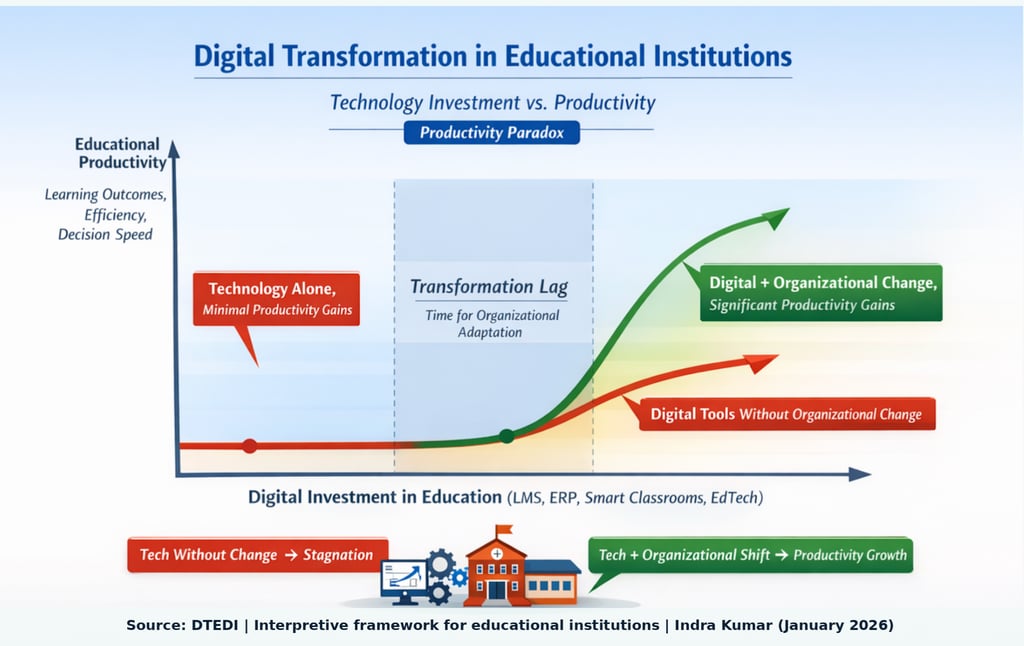
Over time, as institutions redesign teaching models and align incentives, the curve turns upward. Teachers shift from content delivery to learning orchestration, mentorship, and higher-order thinking. Student outcomes improve in ways not immediately visible in test scores but critical to long-term human capital formation.

For management, Brynjolfsson’s research delivers a clear warning: judging AI too early leads to false failure narratives. The initial dip is not inefficiency it is system rewiring. The real gains emerge only after organizational transformation catches up with technological capability.

Key Take away: 

  • Early productivity dips are normal in AI-driven education reform

  • Traditional metrics fail to capture quality and learning gains

  • AI benefits mid-skill teachers the most, not just top performers

  • Generative AI transfers expert teaching behaviours to others

  • AI in education augments, not replaces, teachers

  • Intangible investments drive long-term productivity gains

  • Curriculum and assessment redesign are essential complements

  • Learning quality improves before scores visibly rise

  • Patience is a strategic requirement, not a luxury

  • The true payoff of AI in education is delayed but compounding

  • Digital transformation in education must be managed for the long curve, not the first dip.

Digital Transformation in Educational Institutions